
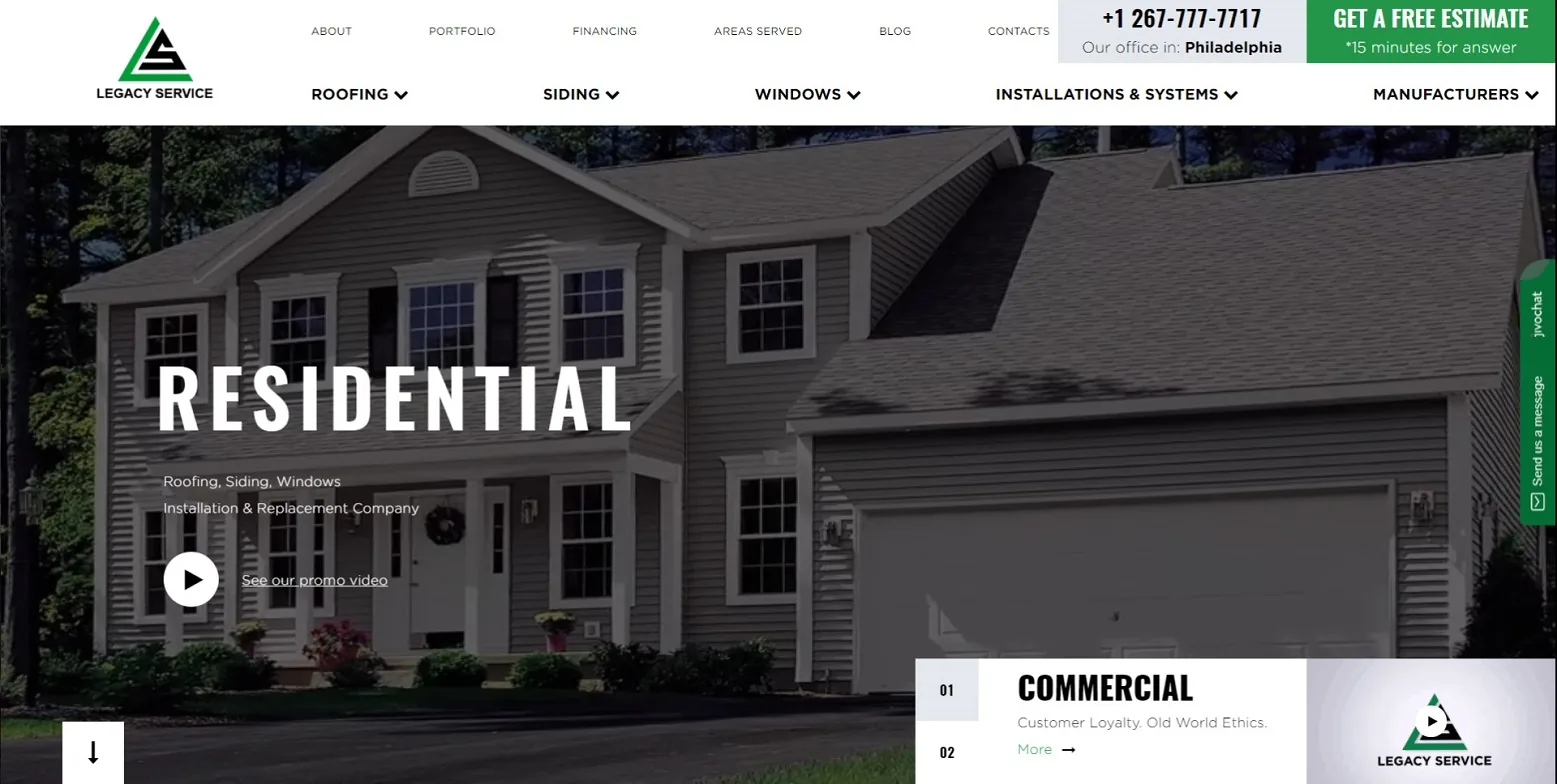
Legacy Service
Residential siding creative. Website and digital work in 1MDE’s public portfolio.
Explore the project story

A website that turns a search into an estimate request.
Your website is where search, ads, video and reviews meet. Siding contractor website design at 1MDE starts with how homeowners choose a siding company: what they want to see, compare and ask before they call. Then we build the pages, the proof and the contact paths around those answers.
Siding company website design has one main job: help a homeowner decide to request an estimate. That starts with a clear service structure, with pages for installation, replacement and repair and a page for each material you install, plus service area pages for the towns your crews cover. A project gallery and project pages show real jobs with before-and-after photos, material, color, scope and location.
Proof sits close to the decision: reviews, warranty information, license and insurance details and any manufacturer certifications you hold. The path to an estimate stays short, with click-to-call, a short estimate form and booking or financing information if you offer it.
Behind the design, speed and mobile layout matter because many homeowners first see your site on a phone, and tracking with GA4, Google Tag Manager, call tracking and form events gives every inquiry a source.
Good design for a siding company is less about decoration and more about answering the homeowner’s questions in the order they ask them. The first is usually cost, so the site explains the factors that affect price, or shares ranges if you’re comfortable doing that. Next comes time: a typical timeline from estimate to finished job. Then the material: plain comparisons of the materials you install, shown on real houses.
Homeowners also want to know who will do the work, so the site introduces your crews, your process and the person they will talk to. Finally, they want to know what happens if something goes wrong, which is where warranty and service after installation belong.
Then we make the next step easy. Calls to action appear in the places people decide, not only at the bottom of the page, and estimate forms ask for a few qualifying fields, such as service, material, address and timeline. On mobile, a sticky call button stays in reach, and confirmation messages tell the homeowner what happens next and when.
A new site should be ready for search from the first day, not fixed afterward. We give each service, material and area its own page and URL, connect services, projects and areas with internal links and add schema markup for your business, services and FAQ. Images are compressed and have descriptive file names and alt text, and the code is clean, fast and set up for correct indexing. Ongoing rankings work is covered on the SEO for siding contractors page.
A redesign makes sense when your current site loads slowly or breaks on phones, can’t easily add new service, area or project pages, doesn’t show where inquiries come from or looks older than the work your crews do today.
If you already rank for some searches, we keep that value during the move: we map old URLs to new ones, set up redirects and check indexing after launch. If you’re changing platforms, domains or hosting, our website migration services cover the move in detail.
We review your services, materials, service areas, competitors, current site and analytics.
We plan the sitemap and each page, write the copy and select project photos with you.
We design and build the site on a staging server and test it on desktop and mobile.
We launch, set up redirects, GA4, Google Tag Manager and call tracking, and monitor the site after launch.
Residential siding creative. Website and digital work in 1MDE’s public portfolio.
Explore the project story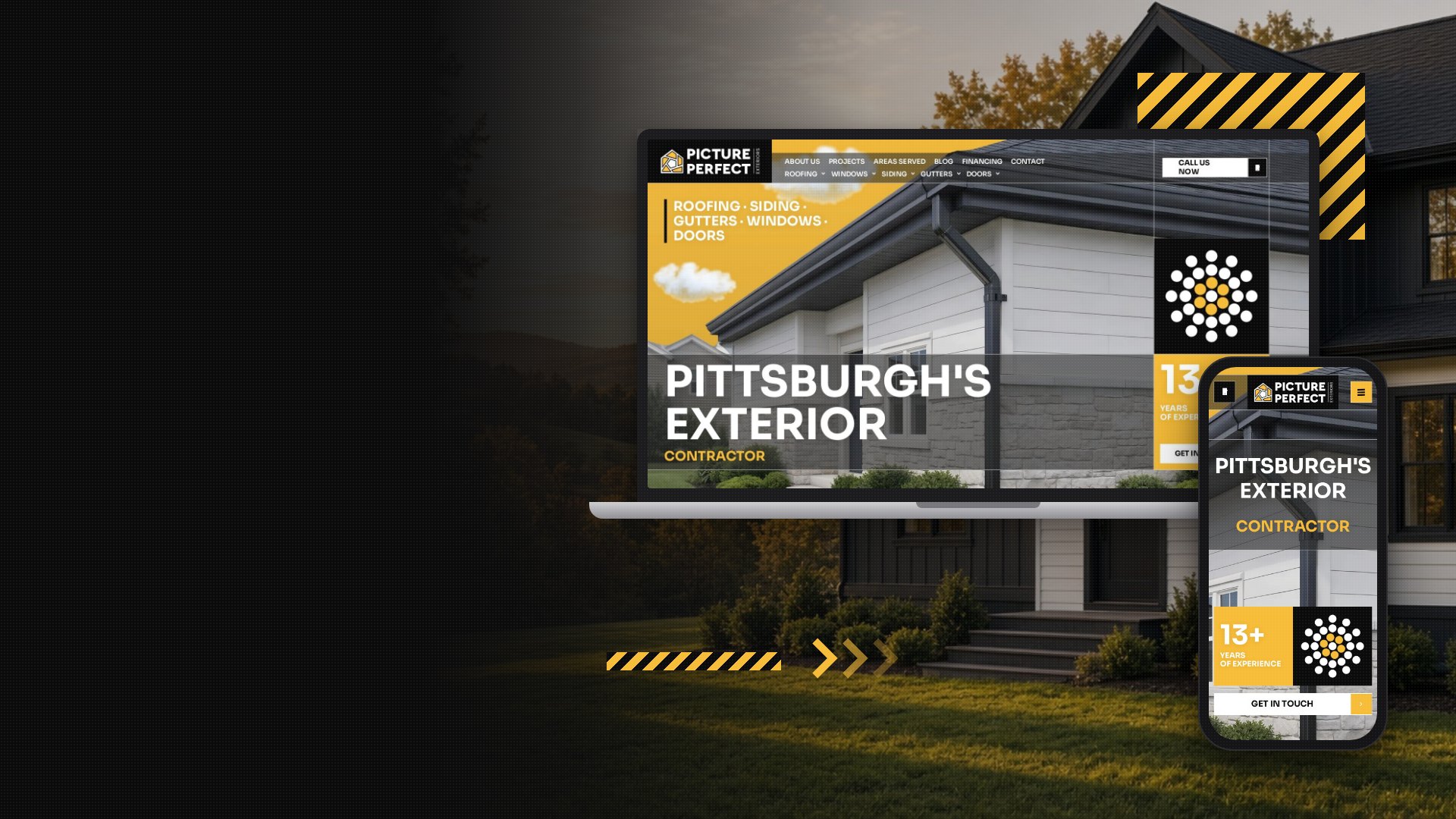
A complete website for a siding, roofing, windows, gutters and doors contractor: nine siding service pages, an areas served page, FAQ, blog and lead forms.
Explore the project storyA siding company website has one job: help a homeowner decide to request an estimate. The site is not a digital brochure, and it is not a trophy. It is the place a homeowner lands after a search, a review, a social post or an answer from an AI tool, and decides whether to call you. The video covers the pages a siding company needs, what quality looks like on those pages, the path from a homeowner’s questions to an estimate, speed, mobile, tracking, the site as a hub and when a redesign comes in.
What the site is for
If you run a siding company, your website has one job: help a homeowner decide to request an estimate. The look, the pages, the speed, and the tracking either support that decision or get in the way. That is what the site is. It is not a digital brochure, and it is not a trophy.
It is the place a homeowner lands after a search, a review, a social post, or an answer from an AI tool, and decides whether to call you. A homeowner finds you on Google, sees your work on social, reads a review on your profile, or hears your name from an AI tool, and then arrives on your site. If the site does not answer their questions and make the next step easy, they leave. It is all connected.
I know that as someone who built a siding company, from zero to twelve million in three and a half years, and who has spent a lot of time studying how companies like ours actually operate. I want to explain what a siding company website is, how it works, what results it is there to support, and how long the search side of that work takes, so you can judge the site as an owner, not as a designer. In my experience, the SEO work around a site takes four to six months to show first results. The site has to be ready for search from the first day: pages that can be indexed, images that load quickly, a clean structure, and the same services, materials, and towns you actually sell.
A build that creates problems for search only delays those months.
The pages
Start with what has to be on the site, and why. The home page has to make it obvious who you are and what you install, show a few real projects, put proof where it can be seen, and make it easy to call or request an estimate. If a homeowner has to hunt for the services or the phone number, the home page is not doing its job. Then come the pages that do the real work: a clear page for each service you actually offer — installation, replacement, and repair, if you do all three — and a page for each material you install.
Service area pages cover the towns your crews actually work. Project pages show completed jobs. Proof — reviews, warranty information, license and insurance details, and any manufacturer certifications you hold — has to be easy to find, not buried in a footer. A siding job is a large, visible purchase.
Those items answer a simple question: can I trust this company with my house. If you also install windows, each trade gets its own service pages and galleries, so a homeowner can find the work they need.
What quality looks like
This is also how quality works on those pages. A weak service page says “we do siding repair” and stops there. A strong repair page explains what a repair covers and when a replacement is the better conversation, shows real repair jobs, and makes it easy to request an estimate. A weak material page is a stock photo and a slogan.
A strong fiber cement page tells a homeowner who that material is for, shows several finished houses with the color, the town, and the scope, includes a short video if you have one, and answers the questions people ask before they call. A weak area page is the same paragraph with a new city name. A strong one shows work in that town, the kinds of homes and siding common there — older homes with wood, or newer developments with vinyl — local rules worth knowing, such as permits or HOA approval where they apply, and reviews from customers in that area. A weak project page is one photo and no details.
A strong one has before-and-after photos, the material, the color, the scope, and the location, so it supports the material page and the area page. A stranger should be able to tell, in a few seconds, what you install and how to reach you.
The homeowner’s questions
Good design for a siding company is not decoration. It answers the homeowner’s questions in the order they ask them, then makes the next step easy. First: what will it cost? The site should explain the factors that affect price, or share ranges if the company is comfortable doing that.
Hiding from the question does not make it go away. Second: how long will it take? A typical timeline from the estimate to the finished job, in honest terms. Third: which material is right for my home?
Plain comparisons of the materials you actually install, with real houses, not a catalog of stock photos. Fourth: who will do the work? Your crews, your process, and who the homeowner will talk to. Fifth: what if something goes wrong?
Warranty and service after installation, stated clearly. Too many sites leave this out.
The path to an estimate
Then there is the path to an estimate, which is how the site turns interest into a real inquiry. The request to call or to ask for an estimate has to appear in the places people decide — after a project, after a material comparison, after the warranty — not only at the bottom of the page. The form stays short: the service, the material, the address, and the timeline. If financing is offered, or a way to choose a time for the estimate, that information belongs where it can be seen, not buried a few steps away.
On a phone, a call button has to stay in reach, because most homeowners will see the site on a phone first. And when someone submits the form or places the call, the confirmation has to tell them what happens next and when. A thank-you page that says nothing is a missed handoff.
Speed and mobile
Speed and mobile are not a polish step at the end. They are how the site works in the real world. If a person has to pinch to read, if the number is buried, if the gallery is awkward, or if the page crawls, a homeowner will leave. Large, uncompressed photos are a common reason a siding site feels heavy.
Compressed images, descriptive file names, and alternative text are part of making the pages usable, and part of making them ready for search.
Tracking
Tracking is how you know whether the site is doing its job. You have to be able to tell whether an inquiry came from a search, a social post, or a saved link. That means analytics, a tag manager, call tracking, and form events, set up so every request has a source. The links on your Google Business Profile belong in that same system: they should send the homeowner to a useful page — a service page or an area page — with tracking, not to a dead end.
If last week’s calls and forms cannot be named by source, the site is not telling you what is working.
The site as a hub
The website is the hub for SEO, video, social, and AI visibility. For search, each service, material, and area needs its own page, with internal links between services, projects, and areas, and with schema markup that labels the business, the services, and the visible questions on the page. For a siding company, that means Local Business, and more specifically Home and Construction Business, plus Service markup for the work you offer. For video and social, the same real projects belong on the matching page, on YouTube, and in a short version on social, so a homeowner can move from the post to the site and still see the same story.
AI tools — Google AI Overviews, ChatGPT, Gemini, Grok, and Perplexity — draw on that same public proof, along with your reviews and your website. A thin site with quiet social pages gives people, and those tools, little to work with.
What conversions to expect
What conversions should you expect from the site itself? The website is the place those search leads land. Here is what I have seen when the site is doing that job for search. From a hundred Maps leads, ninety-seven became appointments, about eighty-seven became a demo, and about twenty-six became a sold job, with the lead around two hundred dollars and the sold job around seven hundred sixty-four dollars.
From a hundred organic search leads, ninety became appointments, eighty-one became a demo, and about twenty-four became a sold job, with the sold job around eight hundred twenty-three dollars. Across search as a family, with a strong sales process, I have seen around thirty to thirty-five percent conversion. A lead still has to be turned into a job. Judge the site by whether a homeowner can get a clear answer and request an estimate, and by whether you can see where that request came from, then by held estimates and signed jobs.
When a redesign comes in
A redesign comes into the picture when the current site is slow or breaks on phones, when you cannot add a new service, area, or project page, when you cannot see where inquiries come from, or when the site looks older than the work your crews do today. Those are the red flags. When you replace the site, protect the search value you already have: old web addresses mapped to new ones, redirects in place, and indexing checked after the move. Treat a platform, domain, or hosting change as a careful migration.
After launch, the team has to be able to add projects, photos, and updates without waiting on a developer. A site that only a specialist can update will fall behind the work you are actually completing, and the proof on the site will stop matching the work on the street. That is how the website stays connected to production, reviews, and the next referral, instead of freezing at the date it was launched. At 1MDE, that is how we approach website design for siding contractors.
We start with how homeowners choose a siding company, we build the pages and the contact paths around those answers, we use your real photos, and we set up the tracking so you can see the source of each inquiry. Want to see how it all connects in your siding company? Follow the link in the description and leave your contact details to get a complete blueprint—from lead generation and sales to production, with the key numbers, workflows and responsibilities mapped out. Thanks for watching.
If this helped you see what a siding company website is actually for, share it with another siding contractor. Chances are, they’re asking the same questions.
Fill out the form to get the Siding Company Blueprint, a complete operating map for a siding company from lead generation to production. Your website is one part of siding contractor marketing as a whole. For your website, the blueprint shows:
It depends on the number of pages and how ready the content and photos are. We give a timeline after the discovery step.
The cost depends on the number of pages, features, content writing and integrations. We provide a quote once the scope is clear.
We map old URLs to new ones, set up redirects and check indexing after launch to keep the risk low. Short-term changes in rankings can still happen after any redesign. For moves to a new platform or domain, see website migration services.
Yes. We write service, material, area and project pages based on your actual work, and we use your real photos wherever possible.
Yes. We build landing pages for Google Ads campaigns and set up call and form tracking, so ad results can be measured. Local Services Ads send homeowners to your Local Services profile rather than your website, but the reviews and project photos on your site still help them decide. See advertising for siding contractors.
Yes. We build the site so your team can add projects, photos and updates without a developer, and we can handle larger changes when needed.
Yes. In windows and siding web design, each trade gets its own service pages and project galleries, so it’s easy to find and can rank on its own.

