

Legacy Service
Residential siding creative. Website and digital work in 1MDE’s public portfolio.
Explore the project story

It’s all connected.
1MDE is a siding contractor digital marketing agency. We bring SEO, paid ads, Google Business Profile management, website design and video together for siding companies, and each service supports the others: the same projects, reviews and pages power your rankings, your ads and your profile on Google Maps.
In practice, that means service, material and service area pages that help homeowners find you in Google Search; Google Ads, Local Services Ads and Facebook and Instagram campaigns for homeowners ready to request an estimate; a Google Business Profile kept active with categories, services, photos, posts and replies to reviews; a website built to turn visits from every channel into estimate requests; and video that shows your projects and crews before the first call.

One company, one connected system.
Marketing doesn’t stop at an inquiry. A healthy siding business connects the appointment, the estimate, the signed sale, the completed project and the next referral. When marketing is judged only by form fills and clicks, nobody can see which channels bring profitable work and which bring calls that never turn into estimates.
1MDE connects the public-facing pieces of your siding company and the tracking around them. Your team still owns sales, production and the customer experience. We make sure each part of the marketing supports the next and that you can see where every inquiry came from.
Every project starts with your business, not a template. This is how we work with siding companies:
We review your website, Google Business Profile, ad accounts, rankings, reviews and tracking, and look at the siding companies competing in your service area.
We choose channels and budgets based on your services, materials, service area, season and how many jobs your crews can take on. You see what we’ll do first and why.
We build or update pages, set up your Google profile and ad campaigns, and connect call and form tracking so every inquiry has a source.
Each month you get a clear report: calls, forms, rankings, ad spend and cost per inquiry by channel. We move budget and effort toward what brings estimate requests.
Siding contractor marketing only works when the owner of a siding company tracks the full path from first impression to a signed job. A homeowner sees your truck on Tuesday, watches a finished-home video on Wednesday, searches on Thursday and sits at the kitchen table with your estimator the following week. If you give all the credit to the last click, you misunderstand your own business. The video covers the pipeline after the lead, who owns each step, the five families of demand and how to choose your next move.
It is all connected
If you run a siding company — whether you just hung the first sign or you have been installing homes for thirty years — I want to start with the same idea: it is all connected. A homeowner choosing siding does not live in your marketing reports. They might see your truck on Tuesday, watch a finished-home video on Wednesday, search siding companies on Thursday, read a couple of reviews, call on Friday, and sit at the kitchen table with your estimator the following week. If you give all the credit to the last click, you will misunderstand your own business.
I know that as someone who built a siding company, from zero to twelve million in three and a half years, and who has spent a lot of time studying how companies like ours actually operate. This video is not a list of tricks, and it is not a reason to turn on every channel today. I want to walk you through how demand shows up for a siding company, who should own each step after it shows up, and how to choose your next move.
A lead is not a job
A lead is not a job. A healthy siding company measures a longer chain: a lead becomes a qualified appointment, that appointment is held as a real estimate, the job is signed, the work is completed, the money is collected and the margin is real, and then a review or a referral can start the next loop. If any one of those steps is weak, more marketing does not fix the business. It just puts more pressure on the weak step.
Who owns what
When I map a siding business, I do not start with ads. I start with responsibility. Marketing is responsible for reaching the right homeowners with a real offer, honest claims, proof of work you actually do, a way to capture the inquiry, and a way to track where it came from. The call or intake team is responsible for answering quickly, qualifying, booking, and confirming.
In a small company that may be you, a spouse, or one person with a headset. The title does not matter. The role has to be owned. The estimator or salesperson is responsible for showing up, walking the house, diagnosing what the homeowner actually needs, presenting a clear proposal, asking for the sale, and writing down what happened — sold, not sold, rescheduled, or no-show.
Production is responsible for quality, schedule, communication, and documenting the work, including photos. That completed project is also the start of your next referral. Accounting is responsible for collecting what is owed, knowing what the job really cost, and telling you whether the profit was what you thought it was. And the owner — even if the owner is also selling and running production — is responsible for capacity, margins, alignment, and accountability.
If marketing fills the calendar beyond what the crew can install well, that is not growth. That is a bottleneck you created. A marketing partner can help you create demand, shape the public-facing pieces, and measure the front of this chain. We cannot run your estimates, install your siding, or own the decisions a homeowner makes.
Nobody owns every action in that journey. That is why it has to be connected on purpose. Demand does not come from one place.
Five families of demand
Lead sources sit in five families. The first is organic, and it has two important branches: referrals and branding. The second is search engines and AI — homeowners who are already trying to hire a siding company. The third is social media.
The fourth is direct marketing, where your company starts the conversation. The fifth is aggregators: businesses that sell leads. If you treat all of those as the same thing, just leads, you will make poor decisions. A neighbor recommending you and a form from a marketplace are not the same object.
They just get stored in the same field if you let them. I am going to share conversion ranges I have seen. Please hear this carefully: I am not comparing them as if they were measured at the exact same step, in the same market, with the same sales team. A homeowner who already trusts you and a stranger who clicked an offer are different events.
Use these as orientation from my experience, then measure your own definitions — appointments held, jobs sold, and what remains after cost.
Referrals
Referrals are usually the highest-quality work you will ever get, because trust already exists. Someone completed a siding project, they were treated well, and they put their name next to yours. In my experience, those inquiries convert at a very high rate. I have seen ninety to ninety-five percent.
I am not calling that a standardized benchmark, and I am not saying it was measured at the same stage as every other channel I will mention. The point is the reason behind it: the relationship did a lot of the selling before you arrived. Referral opportunity grows as you complete more good jobs. It is bounded by your customer base and by whether those homeowners are willing to recommend you.
A simple habit — asking at the right time, making it easy — can encourage that. What it cannot do is turn on like a campaign. You cannot decide on Monday that you need fifty referrals by Friday. Protect this like gold.
Just do not build your entire growth plan on something you cannot scale on demand.
Branding
The other organic branch is branding. I mean the things that make people feel like they already know you: the yard sign after a job, the name on the truck, the shirts your crew wears, a consistent logo, maybe a billboard later. When someone reaches out because they have seen your trucks around town and they already wanted you to do the house, those inquiries have also been strong in my experience — seventy percent and up. Again, that is what I have seen, not a guarantee, and not the same measurement as a cold click.
Branding matters. People hire companies they recognize. The main limit is not that a siding company is unready to work those inquiries. The main limit is the cost of generating a direct lead from branding itself.
Yard signs, trucks, uniforms, and billboards build familiarity and trust, and that is why those conversations can close so well. What they are not is an economical way to buy near-term leads. Here is an illustration from what I have seen — not a study, not a rate card, and not the same measurement as a held estimate. A Facebook ad or a Google ad built for lead generation can run around fifty dollars for a lead.
The cost to get that person to a held demo can land around three hundred to five hundred dollars. A lead that comes from pouring money into branding can run around a thousand dollars. Do not compare that thousand-dollar branding lead to a demo that cost three hundred or five hundred dollars as if they were the same thing. One is the cost of an inquiry.
The other is the cost of a held appointment. The fair comparison is lead to lead: about fifty dollars from a Facebook or Google lead-generation ad, against about a thousand dollars from branding. That is why it is usually easier, and more economical, to run Facebook ads or Google ads when you specifically want leads, rather than pour money into branding and expect the leads to come from there. That is not the same as saying never invest in the brand.
Signs, trucks, uniforms, and a consistent identity still do important work. Branding complements direct response. It should not replace it.
Search engines and AI
Search engines and AI are different. This is the homeowner who already has a need and is asking who to hire for siding nearby. They go to Google, Bing, or a tool like ChatGPT, and they start comparing. Those can be very helpful leads.
They usually come with less trust than a referral or a branded call, and there is more competition standing next to you. In my experience, with a strong sales process, I have seen around thirty to thirty-five percent conversion. If sales is weak, the channel will not save you. This family has several instruments, and they are not interchangeable.
Your local profile and reviews are how people confirm you are real. Search ads can place you in front of someone already typing the need. Local Services Ads can make sense only where siding is eligible in your market. They are not a universal button.
Organic search depends on useful website pages: what you install, where you work, and proof you have done it well. Do not invent product claims you cannot stand behind. And visibility in AI answers uses much of that same proof. There is no separate trick that guarantees a chatbot will recommend you.
Paid search and organic search are both investments, but they behave differently. Paid can move faster, and it stops when you stop. Organic compounds more slowly and still needs real pages and real proof. In either case, the number of homeowners actively looking in your market this month is finite.
Spending more does not create unlimited linear results. And no responsible company should promise that AI tools will recommend you.
Social media
Social is usually a different mindset. Most people scrolling are not actively hiring a siding company today. A strong offer creates interest, they click, and you receive contact details. Then the real work starts: a fast response, a real conversation, and nurture if they are not ready this week.
In my experience, these inquiries often convert lower than search. I have seen around fifteen to twenty percent, though they can perform better than that. I will not stack that number against a referral percentage as if they were the same event. Many social contacts were not shopping when they saw you.
What social can do is reach beyond your past customer list, and it can build familiarity so that later, when someone does search for siding, your name already feels known. There are many networks. You do not need to be everywhere on day one. Paid and organic are different jobs.
Organic is presence and proof — finished homes, useful explanations, a real crew. Paid is distribution of an offer. Spending more does not guarantee linear growth. Two things matter more than the platform name.
The offer has to be real, not bait. And the follow-up has to be fast and human. People gave you their attention. Respect it.
Direct marketing
Direct marketing is when your company starts the conversation: a home show, canvassing or door-to-door, a local event, a cold call. The homeowner did not raise their hand first. You did. On everyday retail siding work, that is a harder sale.
In my experience I have seen around ten to fifteen percent conversion. It can work, and it can scale, but it is labor-dependent. You have to recruit, train, manage, and keep a field team paid and motivated. That is a real operating system, not a weekend tactic.
If you use outreach, follow the rules where you live. Get proper consent before you message people. I am not going to walk you through anything that ignores that. Direct can have a place.
It should not be romanticized, and it should not be ignored. Judge it the same way you judge everything else: can you run it well, and does the completed work leave enough margin after the true cost of generating and selling the job.
Aggregators
The fifth family is aggregators: businesses that sell leads. You have heard names like HomeAdvisor, Angi, Thumbtack, Modernize, and contractor appointment services. Sometimes that lead is shown to several siding companies, not just you. That makes setting a unique appointment and closing the job harder, and those leads can be expensive relative to what you keep.
They can still work if your sales and follow-up are strong. Not every offer in this category is shared. Some are sold as exclusive, so I will not paint them all with one brush, and I will not invent a close rate for the whole group. The rule is simple.
Do not get excited because the lead looked cheap. Judge what it cost you to get a sold job, and what gross profit that job actually left.
How to choose
So how do you choose? If you are earlier in the siding business, do not try to run all five families this week. Get the basics right: a clear identity, a way for people to reach you, someone who answers and confirms, and one or two instruments you can actually handle. For many companies that starts with being findable when a homeowner is already looking — a complete local profile, honest reviews, a useful website that matches the work you actually sell — and with treating every completed job like the start of a referral.
Add paid campaigns, social distribution, shows, or marketplaces only as fast as your intake and production can keep their promises. If you have been doing this for a long time, your problem is usually not that you need more logos on the website. It is a bottleneck. Track sources in cohorts: how many inquiries became qualified appointments, how many of those were held, how many became signed jobs, what it cost to acquire that customer, what margin remained, and whether production had the capacity to install the work well.
Vanity numbers will flatter you. Held appointments, sold jobs, margin, and capacity will tell you the truth. And please do not take a very high referral conversion and a lower social conversion and treat them as a scoreboard against each other. They start from different kinds of trust.
Measure each source against the same definitions inside your company.
One journey
Let me bring it back to the homeowner. They see the sign on the lawn or the name on your truck. Later they catch a video of a finished home. Then they search.
They land on your website, they call, they meet someone at the house. That is one person moving through one world. Your truck did not compete with your website. Your review did not cancel out your ad.
It is all connected. At 1MDE, that is how we think about marketing for siding contractors. The website, the videos, Google — including the local profile, search, and Local Services where you are eligible — social, automation around follow-up, and thoughtful use of newer AI tools should match the work you actually want to be hired for. Publications and press can be part of that picture when they are real.
Nobody can honestly guarantee editorial coverage, rankings, or a chatbot recommendation. We help connect those public-facing pieces and the measurement around demand. We do not pretend to operate your production department or close every job for you. Want to see how it all connects in your siding company?
Follow the link in the description and leave your contact details to get a complete blueprint—from lead generation and sales to production, with the key numbers, workflows and responsibilities mapped out. Thanks for watching. If this helped you connect the dots, share it with another siding contractor. Chances are, they’re asking the same questions.
Website, video, Google and real publications should reinforce the work your siding company wants to win. Each service below is built to support the others, not to compete for the same budget.
Capture homeowners who are already searching, with the right mix of local presence, paid search and a website that answers their questions.
Siding is a large, visible purchase, and homeowners want to see the work before they call. We help you show real projects, real crews and real reviews.
That proof comes in a few forms. Project photos and before-and-after sets from completed jobs show the quality of the work. Video, from project walkthroughs to crew introductions and customer stories, lets homeowners see who will be on their property (see 1MDE video production). And Facebook and Instagram ads put that work in front of homeowners in your service area before they start searching (see the Facebook ads section on the advertising page).
Local Services Ads depend on category and market eligibility. Rankings and ad coverage are not guaranteed.
No single channel does everything. Most siding companies that grow steadily use several channels, each with its own job:
| Channel | Its job | Speed | What it needs |
|---|---|---|---|
| Google Ads | Reach homeowners searching right now | Fast | Budget, landing pages, call tracking |
| Local Services Ads | Pay per lead with a Google Screened badge | Fast, after verification | Eligibility, reviews, quick response |
| SEO and Google Business Profile | Visibility that keeps working without paying per click | Months | Pages, reviews, consistency |
| Website | Turns visits from every channel into estimate requests | Ongoing | Clear services, proof, easy contact |
| Video and project photos | Build trust before the first call | Ongoing | Real projects and people |
| Facebook and Instagram ads | Reach homeowners before they search; remind visitors | Fast | Strong visuals, clear offer |
We connect them instead of running them separately. That gives you one record of where each inquiry came from, so no channel is judged by clicks alone, and budgets move toward the channels that bring held estimates and signed contracts. The same projects, reviews and videos support your website, ads and Google profile at once, and seasonal plans cover the whole year: ads and Local Services Ads in peak months, early-booking campaigns and SEO work in slower months.
As a siding company digital marketing agency, we work with siding businesses of different sizes and specialties. Residential siding companies usually need pages and campaigns for each material they install, whether that is vinyl, fiber cement, wood, engineered wood or metal siding. Commercial siding contractors work on offices, retail buildings and multifamily properties, so their marketing speaks to property managers, builders and business owners rather than homeowners.
Many siding companies also offer other exterior work. Window and siding companies need a windows and siding marketing agency that keeps both trades visible without the pages competing, and roofing and siding companies need roofing and siding marketing services with separate pages and campaigns for each trade (for roof-specific SEO, see Roofing SEO). Exterior remodelers with a siding division fit the same approach: each service gets its own place on the site and in the budget.
Show the work. Skip the inflated claims.
Residential siding creative. Website and digital work in 1MDE’s public portfolio.
Explore the project story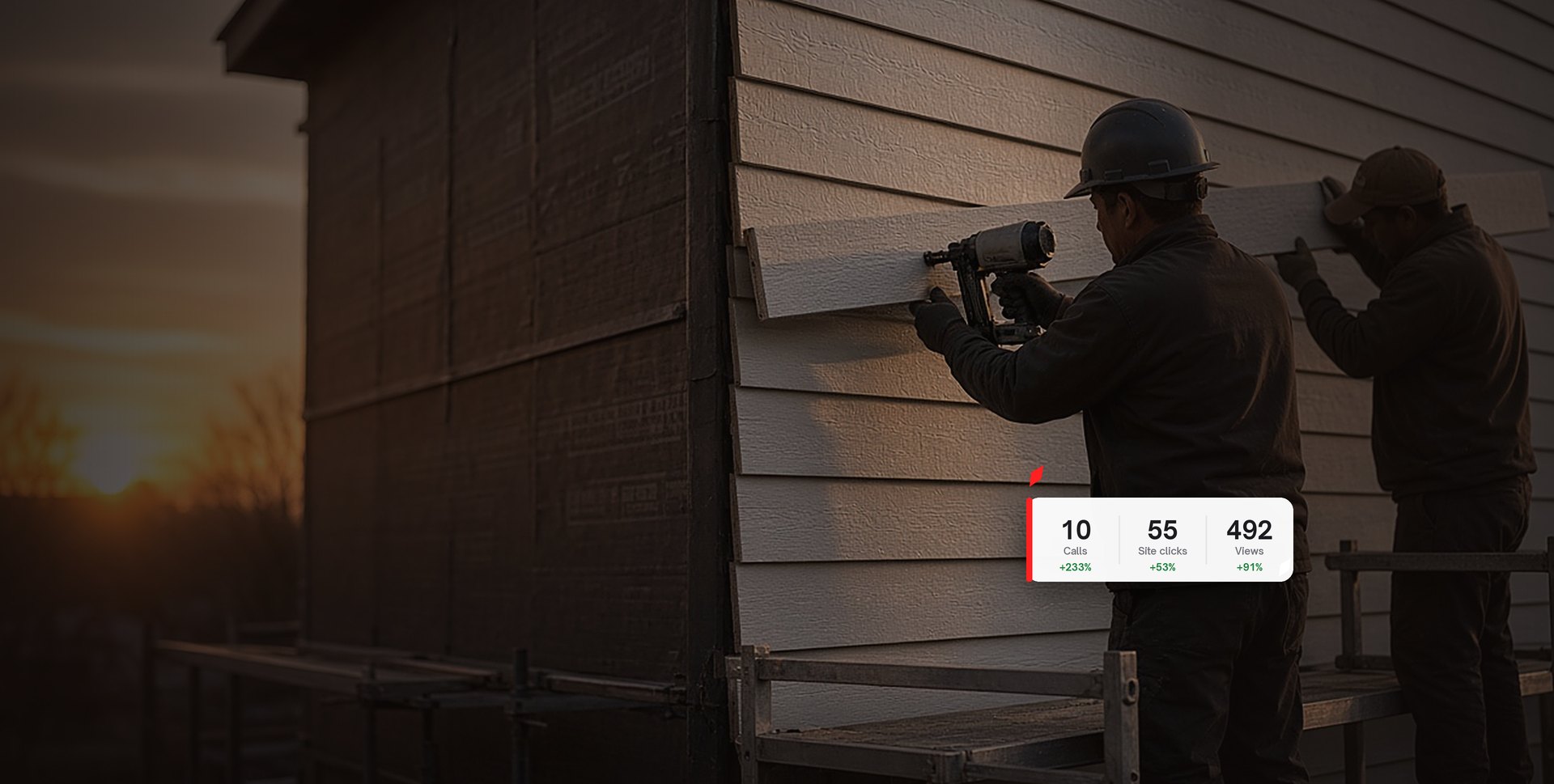
From invisible on Google Maps to the top 3 for “siding installation” across 83% of the service area, held for a year.
Read the case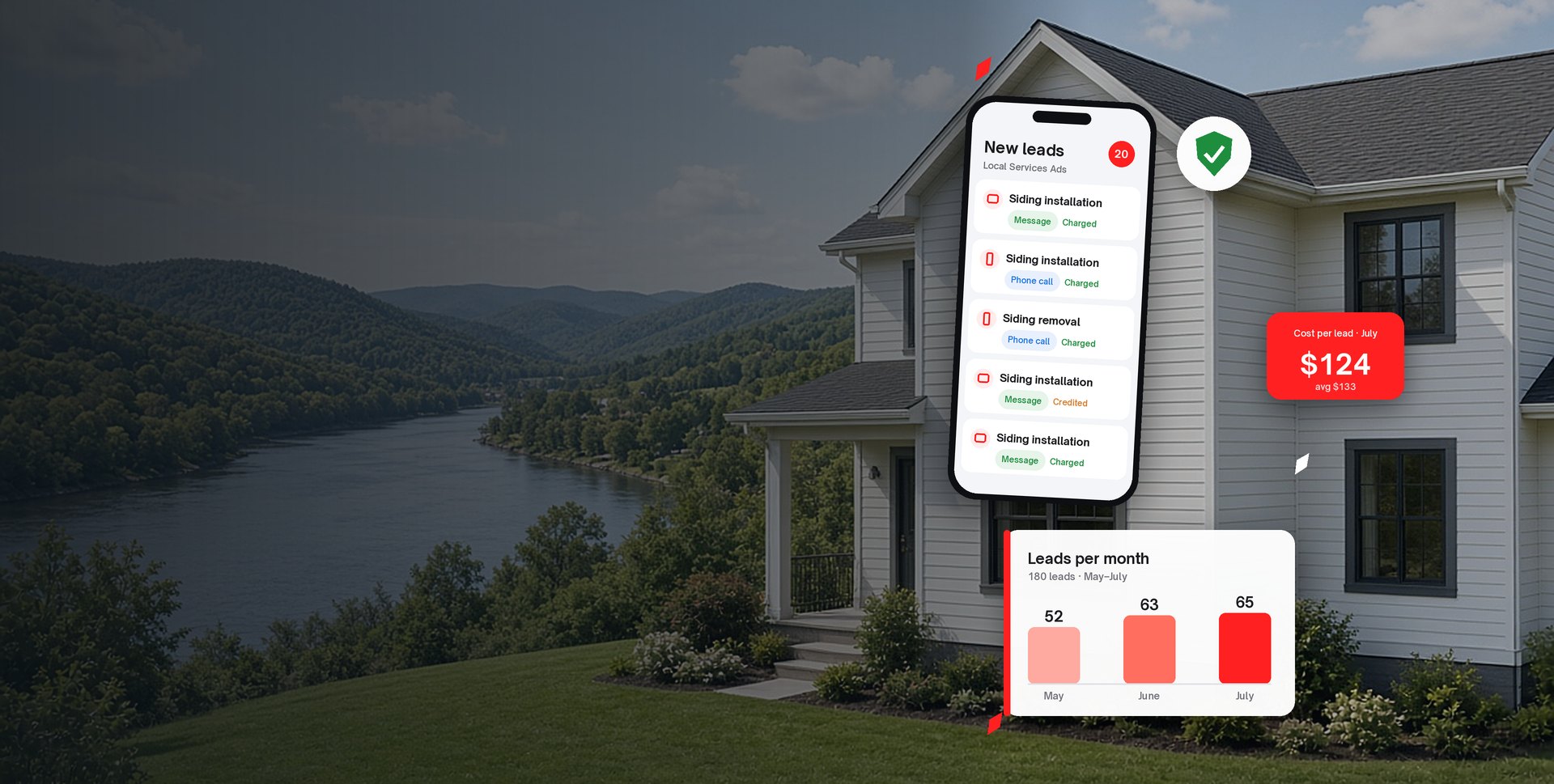
From word of mouth to 50–65 leads a month with Google Local Services Ads, at an average of $133 per lead.
Read the case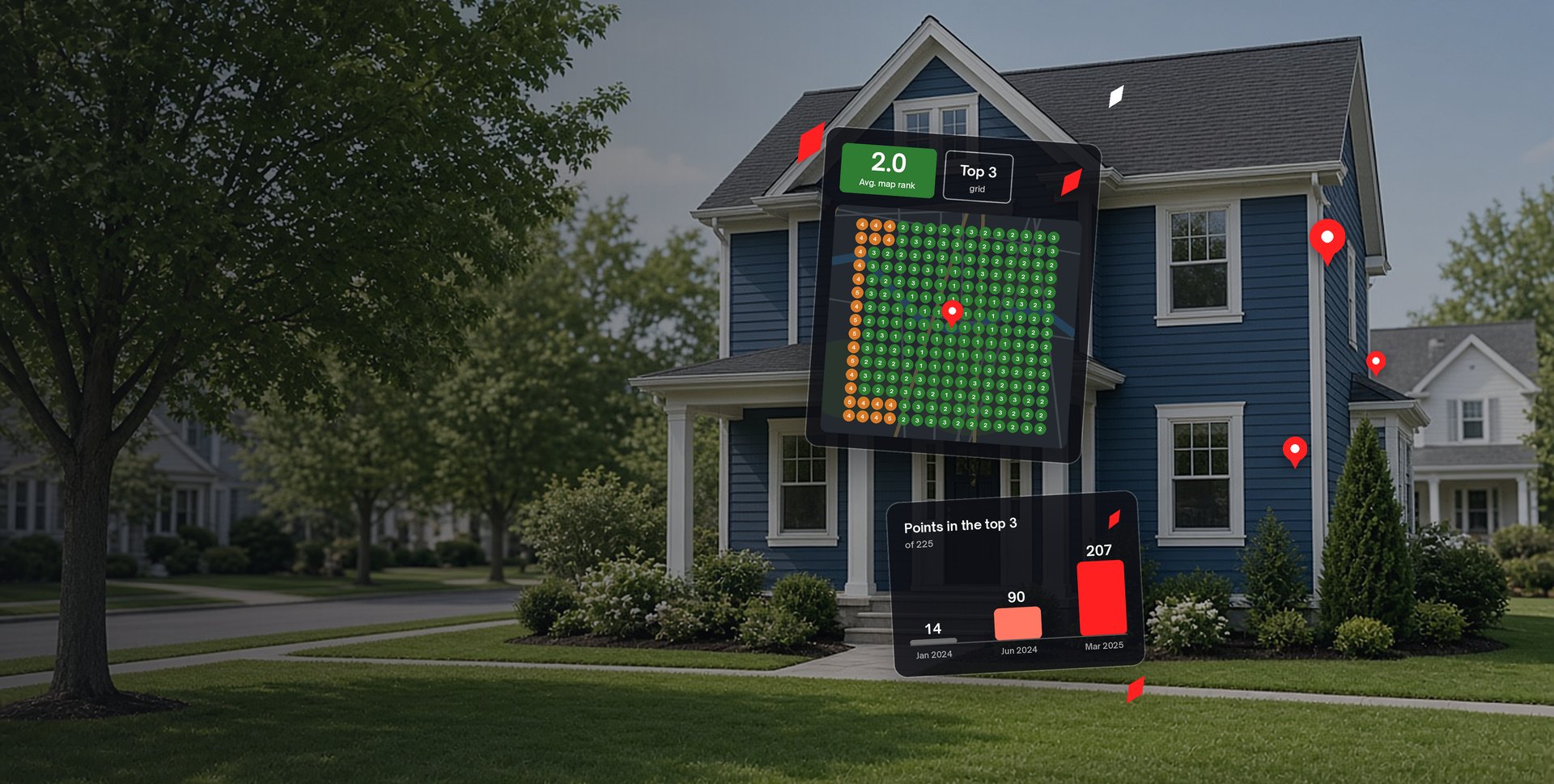
Top 3 on Google Maps for “Hardie siding contractor” across 92% of a 22-by-22-mile area.
Read the caseWe get paid when you close the job. Instead of a flat monthly fee, 1MDE takes an agreed share of the revenue from the jobs our leads bring in, so our pay depends on the same thing yours does: signed contracts.
The rate depends on your trade and average ticket, and it is agreed in writing before we start. Ad spend goes straight to Google and Meta from your own card, so you see every dollar. Every lead, appointment and closed job is tracked in one shared pipeline, so we both see the same numbers and the share is based on them. And we work with one siding company per market, so we never run two companies in the same trade against each other.
A complete operating map for a siding company, from lead generation to production. Fill out the form to get:
It’s a complete operating map for the owner of a siding company: website structure, lead sources, responsibilities at each stage, the company flow from lead to production, call center follow-up, CRM stages, and average conversions and first-year costs by lead source.
No. Leave your contact details in the form and we’ll send the blueprint. If you want to talk it through afterward, you can book a call, but it isn’t required.
Most combine search visibility (Google Ads, Local Services Ads, SEO and a Google Business Profile), proof of their work (project photos, video, reviews) and a website that makes it easy to request an estimate. The right mix depends on your market, season, budget and crew capacity.
We take an agreed share of the revenue from closed jobs that came from our leads. The rate depends on your trade and average ticket and is agreed in writing before we start. Ad spend is paid from your own card directly to Google or Meta.
No. Brand, content and video make each inquiry more likely to become an appointment and a sale, but homeowners still need to find you. Search and ads bring the demand; trust helps you close it.
Yes. Windows and siding get their own pages, campaigns and tracking, so you can see which trade brings which jobs and adjust budgets separately.
