
Legacy Service
Residential siding creative. Website and digital work in 1MDE’s public portfolio.
Explore the project story

Be found before the homeowner calls someone else.
Siding company SEO helps your business appear in Google Search, Google Maps and AI search when homeowners in your service area look for siding installation, replacement or repair. We build the pages, the Google profile, replies to reviews and the technical foundation behind that visibility, then track whether it turns into calls, appointments and signed jobs.
Our SEO services for siding companies aren’t one task. They’re a set of connected pieces, and each one supports the others.
It starts with pages. Each siding service you offer gets its own page, for installation, replacement and repair, and so does each material you install, from vinyl and fiber cement to wood, engineered wood and metal, but only for work you actually do. Service area pages cover the towns and neighborhoods your crews work in, each with local projects and details rather than the same text with a new city name, and project pages show completed jobs with photos, material, color, scope and location.
Around the pages sits your local presence. We manage your Google Business Profile, including categories, services, service areas, photos, posts and replies to every review, and keep your business name, address and phone consistent across directories such as Yelp, BBB, Angi, Houzz and Nextdoor. Clear answers, structured data and consistent business information also help Google’s AI Overviews and AI assistants understand and cite your company.
Underneath it all is the technical work: speed, mobile layout, indexing, internal links and schema markup. Reports show calls, form requests and rankings, and, where your job records allow it, appointments and signed jobs.
Siding has its own search patterns, so a plan built for a plumber or a dentist won’t fit. Homeowners search by material and job type: vinyl siding installation, fiber cement siding, siding repair and siding replacement are separate searches, and one general services page rarely ranks for all of them. The purchase is also large and considered. Homeowners compare portfolios, reviews, warranties and financing before they call, so pages need proof, not slogans.
Timing matters too. Installation searches rise in spring and summer, and repair searches jump after storms, so pages need to rank before the season starts, which makes fall or winter the best time to begin. For searches like “siding contractor near me,” the map results often come first, which is why the Google Business Profile carries so much weight.
Two more details are easy to miss. If your company holds a manufacturer certification or offers a manufacturer warranty, it should be visible on the site and the profile. And siding often shares a site with roofing or windows, so each trade needs its own pages; otherwise Google can’t tell what you do, and the pages compete with each other.
Most siding work is local, so most siding searches have local intent. Local SEO is the part of siding company SEO that decides whether you appear in the map results and for “near me” searches in your area.
Your profile is often the first thing a homeowner sees, before your website. Our siding company Google Business Profile management starts with a primary category that matches your main work, relevant secondary categories, services that match the pages on your website and service areas that reflect where your crews actually work. After that, we keep the profile active with real project photos that describe the material and location, posts about completed projects, seasonal scheduling and offers, and answers to the questions homeowners actually ask. Tracked links show profile visits and calls in your reports.
A strong service area page answers the questions a homeowner in that town has. It shows projects completed in the area with photos, describes the kinds of homes and siding common there, for example older homes with wood siding or newer developments with vinyl, and mentions local rules worth knowing, such as permits or HOA approval, where they apply. Reviews from customers in that area and a clear way to request an estimate complete the page.
We don’t create pages for towns you don’t serve or pages that only swap city names. Google treats those as low-value, and homeowners notice.
Reviews affect both map rankings and the homeowner’s decision. We reply to every review on your Google Business Profile, positive or negative, in a calm and specific way, and give your team a direct review link to send to customers when a job is complete. The most useful reviews naturally mention the service, material and town. Incentives for reviews are not allowed under Google’s policies, so we never suggest them.
Homeowners don’t only scroll through Google results anymore. Many read Google’s AI Overviews or ask AI assistants which siding company to call. Optimizing for AI search builds on the same foundation as regular SEO, with extra attention to how AI tools read and cite a business. Service pages give clear answers to the questions homeowners ask, such as cost factors, material differences and timelines, and project pages show real details: material, scope, location and photos. Structured data labels your business, services, reviews and FAQ, and the same business name, address, phone and services appear on your website, Google Business Profile and directories. Reviews and mentions on the sites AI tools rely on, such as directories and local publications, complete the picture.
No one controls which businesses AI tools mention. This work makes your company easier for them to understand and cite, and it supports regular rankings at the same time.
We review your website, Google Business Profile, current rankings, tracking and the siding companies competing in your area.
We map your services, materials and service areas to pages, so each search has one page that answers it and no two pages compete.
We write and publish service, area and project pages, fix technical issues and update your Google profile.
Each month you see calls, forms, map actions and rankings, and, where your job records allow it, appointments and signed jobs from organic search.
SEO works best when it’s part of the whole system rather than a separate project. Ads bring calls quickly, while SEO builds visibility that doesn’t stop when the budget does, so many siding companies run both: see advertising for siding contractors. Rankings don’t help if the page doesn’t make it easy to request an estimate, and good SEO websites for siding companies do both: see website design for siding contractors. Visibility also only matters if inquiries get answered, which is why the whole system is described on the siding contractor marketing page. Roof-specific pages are covered by Roofing SEO, so siding pages stay focused on siding.
Show the work. Skip the inflated claims.
Residential siding creative. Website and digital work in 1MDE’s public portfolio.
Explore the project story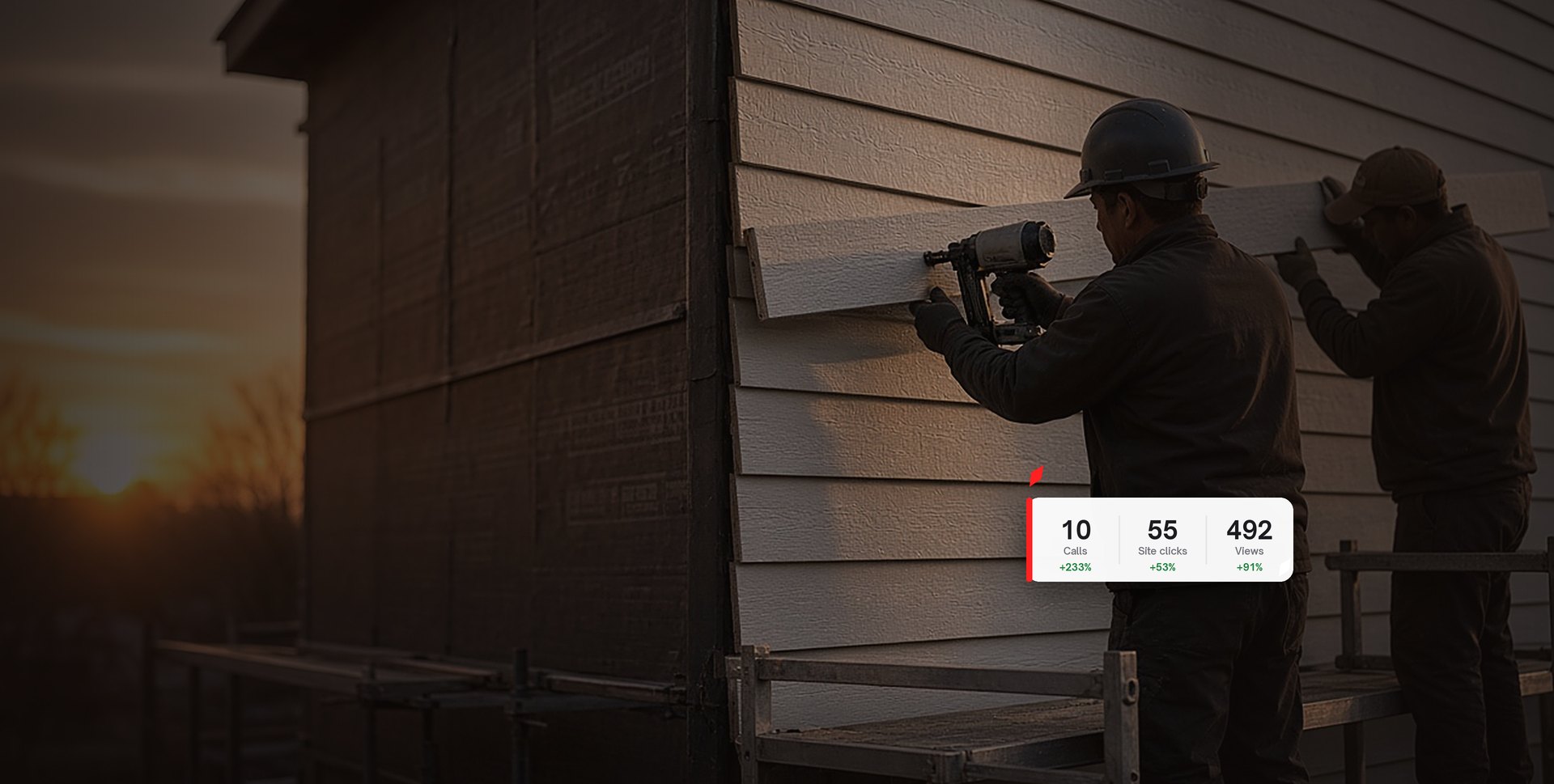
From invisible on Google Maps to the top 3 for “siding installation” across 83% of the service area, held for a year.
Read the case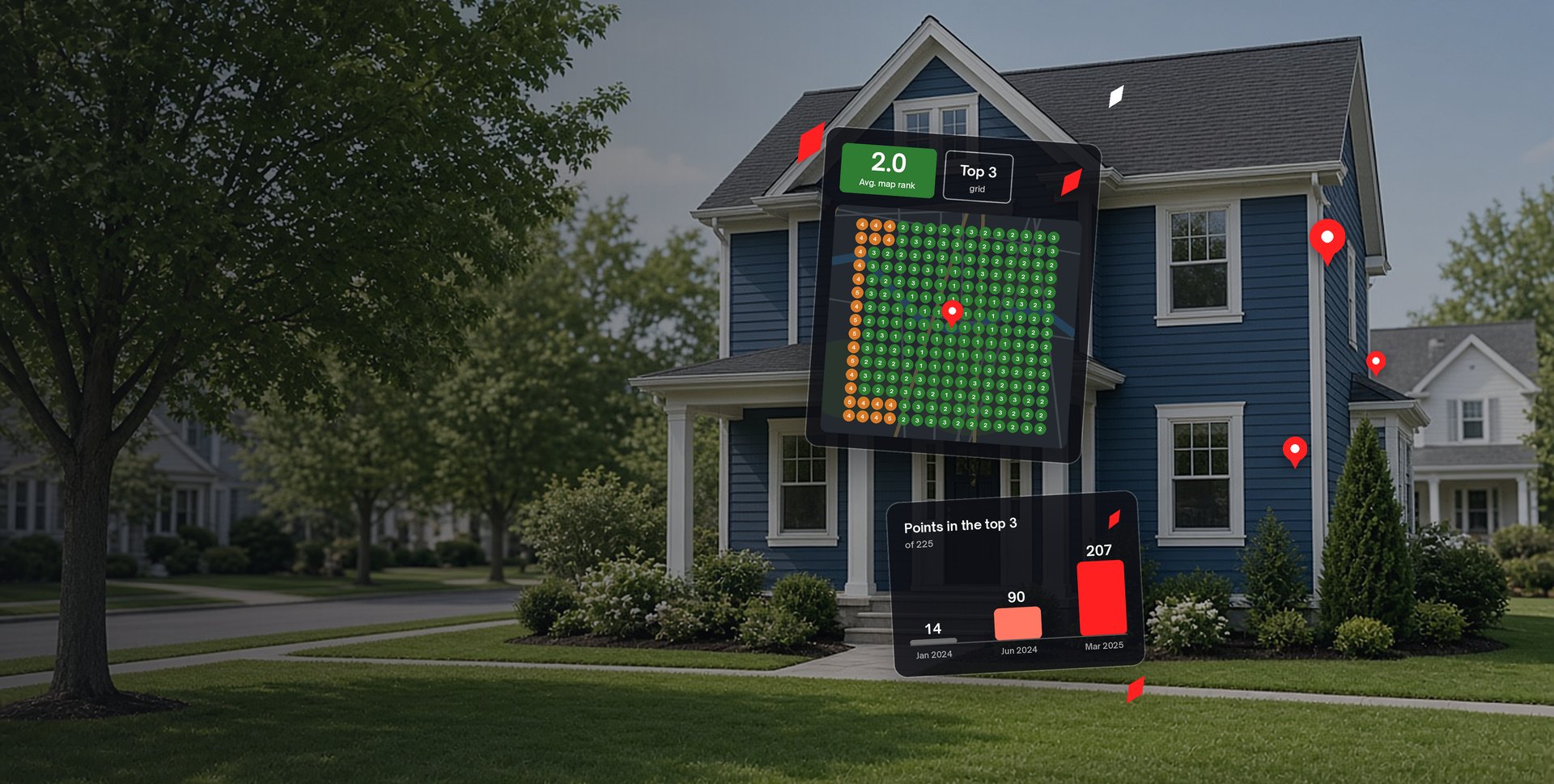
Top 3 on Google Maps for “Hardie siding contractor” across 92% of a 22-by-22-mile area.
Read the caseSEO for a siding company only works when the owner treats the Google Business Profile, the website and AI visibility as one job, not as separate projects. When a homeowner types “siding contractor near me” into Google, they see your listing on the map, your pages in the regular results and sometimes an answer from an AI tool built on that same public proof. The video covers the Google Business Profile and the map, the website and organic search, video, AI visibility and what to measure from the work.
What you are looking at
If you run a siding company, I want to start with something simple, because a lot of owners have never been told this clearly. When a homeowner types “siding contractor near me” into Google, they are not looking at one thing. They are looking at several different parts of the same page. And those parts are not the same job.
First, your Google Business Profile. That is the free listing Google gives your company. It is not your website. It is the card that shows up on Google Maps, and in the map pack — the map with three businesses — when someone searches “siding contractor near me.” On that listing, a homeowner sees your reviews, your photos, your hours, and buttons to call you or get directions.
When people say they found you on Google, a lot of the time they found this listing, not your website.
What SEO is
SEO is search engine optimization. That is the work of getting your own website pages to show up in the regular Google results, the list of links under the map. A page about vinyl siding installation, a page about siding replacement in a town you actually serve — those are SEO. And today, that same work also supports you in AI answers, not only in that list of links.
How they work together
Here is how they differ, and how they work together. The Google Business Profile is how you win the map. The website is how you win the regular results. The website also feeds the profile: the services, the areas, the photos, and the pages you point that listing to.
A strong profile with a weak website is only half the job. A strong website with an empty or neglected profile is also only half the job. It is all connected. At the top of that same page, paid ads sit in their own spots: Local Services Ads, or regular Google Ads.
Those are paid. They are not SEO, and they are not your Google Business Profile. They are a separate part of the page, and this video is not about running ads. AI visibility is the next layer.
Instead of a list of links, a homeowner gets an answer — from Google AI Overviews, and from tools such as ChatGPT, Gemini, Grok, and Perplexity. Those answers are not a separate trick. They are built on a strong website, a complete Google Business Profile, and your presence on social media: how active you are, your follower base, your reviews, and real mentions of your company. I know that as someone who built a siding company, from zero to twelve million in three and a half years, and who has spent a lot of time studying how companies like ours actually operate.
The Google Business Profile and the map
When a homeowner searches “siding contractor near me,” Google chooses which listings appear on the map, and which three go into that pack. It does that with a set of factors that are well established. Proximity is the first one. Google looks at how close your business is to the person searching, or to the place they named in the search.
A homeowner in one town will see a different set of listings than a homeowner two towns over. You show closer to your address, and closer to the towns in your service area, so the address on the listing and the area you say you serve have to match how the company actually operates. Reviews are a major part of prominence — how known and how trusted the listing is. The number of reviews matters, the overall rating matters, and recency matters.
A listing with a strong rating and a steady flow of recent reviews stands in a better position than one that was well reviewed two years ago and has gone quiet. Replies matter as well: a reply shows the owner is present, and it is part of what a homeowner sees when they open the listing. When a customer names the service, the material, and the town, that content is useful. Incentives for reviews are not allowed under Google’s policies.
The primary category is how Google understands the main work, and it has to match the work you actually sell. Secondary categories cover the other work you genuinely do. The wrong primary category, or a pile of categories you do not serve, makes the listing less relevant. Relevance, proximity, and prominence are the three things Google uses to decide who appears.
Completeness is easy to leave unfinished, and it counts. Hours, services, a real description, the phone number, the buttons a homeowner uses to call or write, and the rest of the fields Google offers — a complete listing gives more to work with than a half-filled one. Complete profiles perform better. Photos do real work here.
Project photos, crew photos, and photos of completed homes give a homeowner something to judge, and listings with photos get more engagement: more calls, more direction requests, more visits to the website. Fresh photos from recent jobs keep that proof current. Posts and ongoing activity keep the listing alive over time. A post about a completed job, an answer to a question, an update to hours or services — that is the difference between a profile that is being used and one that was set up once and left alone.
The website link on the listing has to be relevant. It should take a homeowner to your own site, and to a page that matches the company and the work, not to a generic or unrelated page. The name, address, and phone number have to stay consistent. That is NAP: the same name, the same address, and the same phone, on the listing and on the directories people already use, such as Yelp, BBB, Angi, Houzz, and Nextdoor.
When those do not match, Google is looking at conflicting information, and the listing is weaker for it. The service area should match where your crews actually go. Towns you name and never serve, or towns you work every week and never list, both make the profile less accurate. The service area is part of who even sees the listing.
None of this is a one-time setup.
Free leads from the map
The leads from this listing are free. You do not pay Google per click, and there is no ad auction on the map pack itself. The investment is the work behind the listing. From a hundred Maps leads, ninety-seven became appointments, about eighty-seven became a demo, and about twenty-six became a sold job.
A Maps lead has run around two hundred dollars, and a sold job on that path around seven hundred sixty-four dollars. This takes up to three months of consistent work to show first results. The organic work is the website.
The website and organic search
A siding company needs one clear page for each service it actually offers — installation, replacement, and repair, if you do all three — one page for each material you install, and one page for each town or neighborhood your crews actually cover. Each page is meant to answer a real search. Pages for work you do not do, or towns you do not serve, and the same text with a swapped city name, are weak pages. A homeowner will see that.
If you also install windows, those pages stand on their own, so the two trades do not compete. And the web address should read like the page: a vinyl page should look like a vinyl page in the address, not a random string of numbers.
Page quality
Page quality is where most siding sites fall short, and it is also how the page earns trust. A weak vinyl page says, “We install vinyl siding,” shows a stock photo, and leaves a form at the bottom. A strong vinyl page tells a homeowner whether vinyl is a fit for their house. It shows several real jobs with the material, the color, the town, and the scope.
It answers the questions people ask. And it makes it easy to request an estimate. A weak area page is the same text with a new town name. A strong area page shows projects completed there, the kinds of homes and siding common in that town, local rules worth knowing, such as permits or HOA approval where they apply, reviews from customers in that area, and a clear way to request an estimate.
A weak project page is one photo with no town, no material, and no description. A strong one shows before and after, names the material and the color, explains the scope, and says where the house is, so it supports the material page and the area page. Keywords on a weak page do not finish the job.
Technical work
Underneath the words and the photos is the technical work. This is how search engines, and homeowners on a phone, actually reach the page. Pages have to load quickly, especially on a phone, because that is how most homeowners will see them. The layout has to work with a thumb: text you can read, buttons you can tap, a phone number you can reach.
The right pages have to be indexed, meaning search engines are allowed to find them. And the pages have to link to each other in a way that makes sense — a fiber cement page that points to fiber cement projects and to the towns where you have installed it, not a dead end. Large, uncompressed photos are a common reason a siding site crawls on a phone. Descriptive file names and alternative text on those photos are part of the same foundation.
Schema markup
Schema markup is a label on the content, not a substitute for it. It spells out, in a form search engines and other tools can read, what the page is about: who the business is, what services you offer, which questions you answer. For a siding company, that means marking the business as a LocalBusiness, and more specifically as a HomeAndConstructionBusiness, and marking each service as a Service. If a page has visible questions and answers, those can be marked as FAQ content.
Those questions help the homeowner. There is also Review markup. If reviews appear on a page, they have to be real, visible, and not incentivized. Markup has to match what a person can see on the page.
The leads that come from these pages are free in the same way: there is no cost per click, and you are not bidding for the regular results. The investment is the work on the site. From a hundred of those search leads, ninety become appointments, eighty-one become a demo, and about twenty-four become a sold job. The lead has run around two hundred dollars, and the sold job around eight hundred twenty-three dollars.
Across search as a family, with a strong sales process, that conversion has run around thirty to thirty-five percent. A lead, a demo, and a signed job are three different steps, and the result is held estimates and signed jobs. SEO takes four to six months to show first results.
Video
Video is part of this work. A walkthrough of a vinyl job belongs on the vinyl page and on that project page, not only on a phone in the truck. A YouTube channel organized around the work you actually sell — installation, replacement, repair, and the materials you install — supports those same pages and gives search engines real footage to find. Short videos on social media work the same way when they show that same work, not a random mix with no connection to the pages you want people to find.
One walkthrough, used on the page, on YouTube, and on social, tells one story. What affects the result is real jobs, the material and the town named clearly, and a consistent body of work, not a burst of videos and then silence. You do not pay per click for this either. The investment is filming the work you already do and putting it where a homeowner, and a search engine, can use it.
Video supports the pages and the profile, and it moves on the same clock as that work.
AI visibility
When a homeowner asks an assistant a question like “best siding contractor near me,” or “vinyl versus fiber cement,” the tool assembles an answer from public proof it can find. What affects that is a strong website, plus social activity, a real follower base, honest reviews, and genuine mentions. A clear site and an active social presence give the tool a real body of proof. You do not pay per click to appear in one of those answers.
The timeframe follows the work underneath it.
How it all connects
A homeowner does not experience these as separate projects. They search, they see a listing, they open a page, they watch a short video, they look for reviews, and some of them will also ask an assistant. The work only holds if those pieces describe the same company. What you measure is calls, form requests, and map actions, and, where the job records allow it, held estimates and signed jobs.
At 1MDE, that is how we approach SEO for siding contractors. Want to see how it all connects in your siding company? Follow the link in the description and leave your contact details to get a complete blueprint—from lead generation and sales to production, with the key numbers, workflows and responsibilities mapped out. Thanks for watching.
If this helped you see how search actually fits a siding company, share it with another siding contractor. Chances are, they’re asking the same questions.
Fill out the form to get the Siding Company Blueprint, a complete operating map for a siding company from lead generation to production. For search, it shows:
Google Business Profile and map improvements can show within weeks. Organic rankings for competitive siding searches usually take several months, depending on your website, your area and your competitors. Because siding demand is seasonal, starting in fall or winter gives pages time to rank before spring.
Local SEO focuses on Google Maps, your Google Business Profile, reviews and service area pages. Regular SEO focuses on your website’s pages and technical health. For siding companies both matter, so we work on them together.
If you install the material and homeowners in your area search for it, yes. A dedicated page answers questions about that material, shows your projects with it and has a much better chance of ranking than a general list.
Over time it can reduce how much you depend on ads, but it takes months to build. Many siding companies use ads during peak season and SEO for steady inquiries all year.
By calls, form requests, map actions and rankings for your main services and areas. Where your job records allow it, we also track appointments and signed jobs from organic search.
Yes. Windows and siding SEO works best when each trade has its own pages and keywords, so both can rank for their own searches without competing with each other.
Yes. We work on your pages, Google Business Profile and directory listings so Google’s AI Overviews and AI assistants can understand your services and service area. Visibility in AI search can’t be guaranteed, but the same work also supports regular rankings.
We take an agreed share of the revenue from closed jobs that came from our leads, including leads from Google Search and Google Maps. The rate depends on your trade and average ticket and is agreed in writing before we start.

