
Legacy Service
Residential siding creative. Website and digital work in 1MDE’s public portfolio.
Explore the project story

Pay for inquiries that can become signed jobs.
Siding contractor advertising puts your company in front of homeowners who are ready to talk about new siding now. As a targeted advertising service for siding contractors, we build and manage Google Ads, Local Services Ads and Facebook and Instagram campaigns, and we judge every campaign by booked appointments and signed work, not by clicks. We get paid from a share of the jobs our campaigns bring in, so our pay depends on signed contracts too.
We handle the whole campaign, not only the ad account. Each campaign, service and offer gets its own landing page, and we write the ad copy and prepare the images and video for search ads and for Facebook and Instagram. Tracking for Meta and search engines, including pixels, conversion tracking, GA4 and call tracking, shows which campaigns, ads and pages bring inquiries. Then we compare results and move budget toward the campaigns that bring booked appointments, so optimization follows what converts, not what gets clicks.
Each paid channel reaches homeowners at a different moment. As a siding PPC company, we choose the mix based on your market, services, season and how many jobs your crews can take on. We also run PPC for remodelers and siding contractors who offer several exterior services, with a separate campaign for each service.
Search ads are the core of PPC for siding contractors. They show up when a homeowner types what they need, which makes them the fastest way to reach people ready for an estimate. We build separate campaigns by service and material, such as installation, replacement, repair, vinyl and fiber cement, and bid on keywords with buying intent like estimate, installation, replacement and “near me.” Negative keywords block wasted clicks from DIY searches, how-to videos, job seekers, wholesale materials and services you don’t provide. Location targeting matches your real service area, and the ad schedule matches when someone can answer the phone. Call, location and image assets give the ads more space and show your work, and each campaign leads to its own landing page instead of the home page.
Local Services Ads appear above regular search ads and are paid per lead, not per click. Eligible businesses can display the Google Screened badge after Google checks the business through background, license and insurance verification. Reviews and fast responses help the ad show more often, and leads that don’t match your services can be disputed with Google. Availability depends on your business category and market, so we confirm eligibility before planning around it.
Facebook and Instagram reach homeowners before they start searching and remind people who already visited your site. Before-and-after carousels and short project videos show the work, and retargeting reaches website visitors who didn’t request an estimate. Lead forms ask a few qualifying questions, such as homeowner status, project type and timeline. Seasonal campaigns, such as early booking for spring or financing offers if you provide financing, keep demand steady, and targeting by service area keeps the budget where your crews work.
Many contractors buy shared leads from lead marketplaces, where the same homeowner can be sent to several companies at once. Siding company lead generation through your own campaigns works differently: every inquiry comes from your ad, goes to your phone or form and isn’t sold to anyone else.
| Shared lead services | Your own ad campaigns | |
|---|---|---|
| Who gets the inquiry | Often several contractors | Only your company |
| Whose brand the homeowner sees | The marketplace | Yours |
| Cost control | Price per lead set by the vendor | Your budget, bids and targeting |
| Data you keep | Limited | Search terms, ad results, conversion data |
| After you stop paying | Nothing remains | Remarketing audiences, reviews and brand searches |
Not every inquiry is worth a truck roll. We focus campaigns on siding installation leads and replacement projects, and filter for siding sales leads that fit your business: the person owns the home or manages the property, the address is inside your service area, the job is something you offer in a material you install, and the project size and timeline fit your schedule. We filter through ad wording, negative keywords, form questions and call tracking, and we review search terms and lead quality with you regularly.
A campaign is judged by what happens after the inquiry, so tracking goes past the form fill. Call tracking and call recording show which ads bring real conversations, and every campaign has form and lead source tracking. We review lead quality with your team regularly: which inquiries became appointments and which didn’t fit. Where your sales records allow it, signed jobs are sent back into Google Ads as conversions, so campaigns learn from sales, not form fills.
See how marketing connects to your sales process on the siding contractor marketing page.
We review your market, competitors, search demand by service and material, and any existing ad accounts and tracking.
We set up call and form tracking, campaigns and landing pages, and connect conversion data where your sales records allow it.
We launch with a controlled budget and test ads, landing pages and offers against each other.
You see cost per inquiry, per booked appointment and, where tracked, per signed job, and we move budget toward what produces work.
Ad spend is paid directly to Google or Meta from your own card. 1MDE is paid an agreed share of the revenue from closed jobs that came from our campaigns, not a flat management fee. How much to spend on ads depends on how competitive your market is, the size of your service area, which services and materials you advertise, how many jobs your crews can take on each month and the season.
Seasons shape the budget as much as the market does. Spring and summer bring peak demand for installation and replacement, so budgets usually go up. After storms, repair searches rise quickly, and repair campaigns should be ready to switch on. Fall is still active and a good time to fill the schedule before winter, while winter brings lower search volume and is the right time for remarketing, early-booking offers for spring and keeping Local Services Ads running.
Show the work. Skip the inflated claims.
Residential siding creative. Website and digital work in 1MDE’s public portfolio.
Explore the project story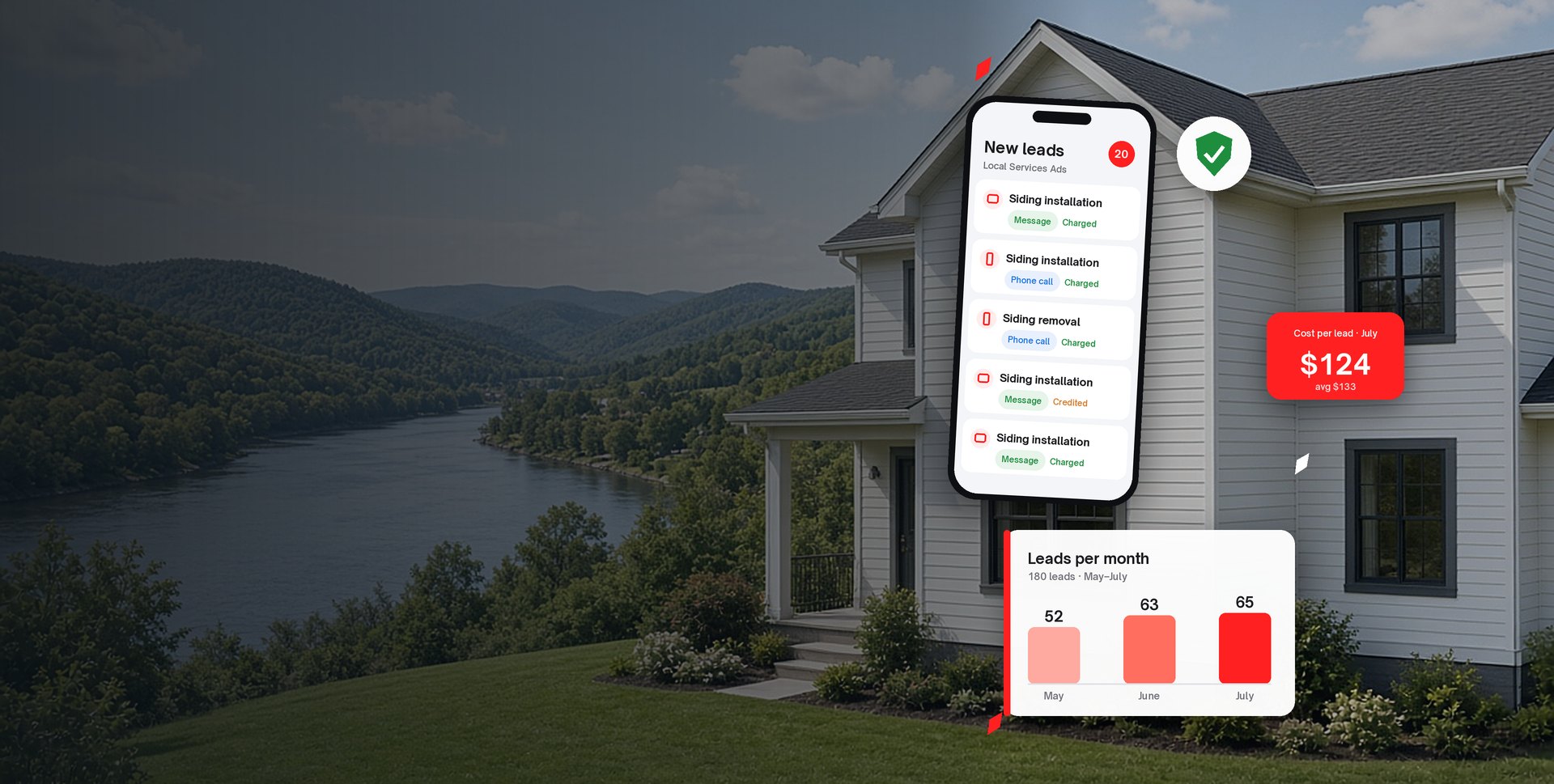
From word of mouth to 50–65 leads a month with Google Local Services Ads, at an average of $133 per lead.
Read the caseSiding contractor advertising only works when the owner of a siding company tracks a homeowner from the ad, to the call or the form, to a held estimate, to a signed contract. Paid advertising buys attention from homeowners who fit your service area and the work you do. The video covers Google Ads, Local Services Ads, Facebook and Instagram, lead forms, branding and costs, teaching the platforms what converts, other channels, budget and season, and how it all connects.
The click is not the result
If you run a siding company, I want to start here. Paying for clicks is not the same as paying for inquiries that can become signed jobs. Paid advertising is how you buy attention from homeowners who fit your service area and the work you do, and then track that person from the ad, to the call or the form, to a held estimate, to a signed contract. The click is not the result.
The sold job is. I know that as someone who built a siding company, from zero to twelve million in three and a half years, and who has spent a lot of time studying how companies like ours actually operate. I want to explain what these ads are, how they work, what conversions to expect, and how long the system takes to tell you the truth. Advertising is connected to your website, your SEO, your video, your social presence, and the people who answer the phone.
It is all connected.
Three channels, three moments
Each paid channel reaches homeowners at a different moment. Google search ads show up when a homeowner types what they need. They are the fastest way to reach people already ready for an estimate. If a siding company starts with one paid channel, this is the one.
Local Services Ads, where you are eligible, appear above those regular search ads. You pay per lead, not per click, and eligible businesses display the Google Screened badge. These ads only belong in the plan where siding is eligible in the market. Facebook and Instagram reach people before they search, and remind visitors who left.
Those contacts need more qualification, because many were not hiring a siding company today. Other channels come later, after the core system and the tracking are working.
Google Ads
Here is how Google Ads works when it is built for a siding company. A weak setup pours every service and material into one campaign and sends every click to the home page. A strong setup separates campaigns by service and material — installation, replacement, repair, vinyl, fiber cement, and the other materials you offer — and each one goes to a page about that same job. The ad has to match the search, and the page has to match the ad.
An installation campaign bids on searches like vinyl siding installation near me, or siding installation estimate, with headlines about local installation and a way to request an estimate. A replacement campaign stays on replacement. A repair campaign stays on repair, especially after a storm. Keywords with buying intent — estimate, installation, replacement, and “near me” — are how you reach people who are ready to talk.
Negative keywords are how you avoid paying for the wrong searches: how to install siding, do-it-yourself siding, siding contractor jobs, wholesale siding, siding supplies. The ads should run in the area your crews actually cover, and at hours when someone can answer the phone. If the landing page does not show the service the person just searched, the campaign is already leaking. From a hundred of those Google Ads leads, I have seen seventy become appointments, sixty-three become a demo, and about nineteen become a sold job.
In the first-year costs I have seen, that lead has run around three hundred fifty dollars, the demo around five hundred fifty-six dollars, and the sold job around one thousand eight hundred fifty-two dollars. Those are sold jobs from a hundred leads.
Local Services Ads
Local Services Ads work differently. They are paid per lead, and they display the Google Screened badge where you are eligible. Google verifies background, license, and insurance first, and the ads start after that is complete. Reviews and fast responses are part of how those ads are ranked.
Unmatched leads can be disputed, and if they are not, you are paying for inquiries you will never run. Where you are eligible, these ads and regular Google Ads are two different instruments, and they belong together, not as a replacement for each other. From a hundred Local Services leads, I have seen eighty become appointments, seventy-two become a demo, and twenty-two become a sold job. The lead has run around one hundred fifty dollars, and the sold job around six hundred eighty-two dollars.
That is a stronger funnel than a mixed form-and-call search campaign.
Facebook and Instagram
Facebook and Instagram work earlier in the journey. A weak ad is a logo, a slogan, and a generic line with no proof. A strong ad shows the work: a before-and-after of a real house, a close look at the material and the trim, or a short crew walkthrough of a finished elevation, and a clear way to request an estimate. Targeting has to match the towns you will actually drive to.
That is how the channel works. What you should not expect is that every name in the dashboard is a homeowner ready to hire a siding contractor this week.
Lead forms
This is where lead forms matter, and it is where a lot of siding companies waste money. In my experience, leads that come through Facebook lead forms — the instant forms that open inside Facebook or Instagram — are much weaker for a siding company than leads that come from a dedicated landing page. The issue is conversion quality, not the number of names in the dashboard. An instant form is built for speed.
The contact details are already filled in. The person submits it with almost no effort. There is little friction and little intent. They have not seen your projects, your reviews, or how you work, and many do not even remember sending the form.
A landing page works differently. The homeowner leaves the feed, opens a page, and chooses to stay. They see the work, the proof, and the reviews, and then they submit a form or call. That extra step filters for people who actually want to talk.
Fewer inquiries is not a worse campaign. I have seen that difference in the numbers. From a hundred social ads leads that came in as forms, fifteen became appointments, about fourteen became a demo, and about four became a sold job. The lead itself looks cheap — around thirty dollars in the first-year costs I have seen — but the sold job on that path has run around seven hundred forty-one dollars.
Compare that with social posting and reels, where the mix is closer to half calls and half forms. From a hundred of those, I have seen a hundred appointments, ninety demos, and twenty-seven sold jobs, with the sold job around three hundred seventy dollars. The form is not the same object as a homeowner who chose to call or to stay on a page.
Branding and a cost illustration
Here is an illustration from what I have also seen, and I want you to keep the measurements separate. A Facebook ad or a Google ad built for lead generation has run around a hundred dollars on average for a lead. The cost to get that person to a held demo has landed around three hundred to five hundred dollars. A lead that comes from pouring money into branding has run around a thousand dollars.
Do not compare that thousand-dollar branding lead to a demo that cost three hundred or five hundred dollars as if they were the same thing. One is the cost of an inquiry. The other is the cost of a held appointment. Branding complements direct response.
It should not replace it, and it should not be judged as a cheap way to buy near-term leads.
Teaching the platforms what converts
The Meta Pixel, Google Ads conversion tracking, and the tracking on every other platform need to understand what converts and what does not. If the platform only sees form fills, it looks for more form fills, including junk. It cannot tell the difference unless it is taught. On Meta, the Pixel records visits, forms, and call clicks, and the Conversions API sends those same events from the server, which is more reliable than the browser alone.
When a lead is qualified, an estimate is held, or a job is signed, those later stages have to be sent back as well. In Google Ads, the click, the call, and the form are the start. The upgraded version of sending the later result back is called enhanced conversions for leads. It uses an email or a phone number the homeowner already gave you to match the held estimate or the signed job back to the original click.
If a campaign is optimizing only for a form fill, the platform is being trained on the wrong event. The first weeks are a test. The algorithms improve after they have enough real outcomes.
One inquiry all the way through
Let me walk one inquiry all the way through, so you can see how the system is supposed to work. A homeowner searches for fiber cement siding installation near me and clicks the ad. They land on a fiber cement installation page, not the home page, and see photos, reviews, and a way to request an estimate. They call or send the form.
The team answers quickly, confirms the fit, holds the estimate, and they sign the job. Then that signed job is sent back to Google Ads as a conversion, so the campaign learns from a real sale, not just a form fill. Most companies skip that last step. If the chain breaks — the wrong page, a slow answer, no qualifying, or no conversion sent back — raising the budget does not fix it.
Other channels
Once that core system is working, other channels are tested. They should not be the starting point. Microsoft Advertising includes Bing, with the same kind of search intent and a smaller audience than Google. YouTube ads show the work and remind people who visited your site.
Nextdoor is built around neighborhoods, where neighbors already ask for a local siding contractor. TikTok is a visual platform, and before-and-after siding projects get attention there. Ads in ChatGPT are a new channel. OpenAI shows clearly labeled ads in ChatGPT, separate from the answers the assistant gives, and those ads do not change the answers themselves.
They are shown on the free and lower-cost plans, not on the higher paid plans, and there is a self-serve ads manager in the United States. Judge any new channel the same way: held estimates and signed jobs, after the core tracking is working. None of them replaces Google search or Facebook and Instagram.
Budget and season
A siding advertising budget has two parts: ad spend paid to the platforms, and campaign management. Those two costs should be visible separately. The right spend is set by the market, the area, the work being advertised, crew capacity, and the season. Spring and summer are peak demand for installation and replacement.
After storms, repair searches rise quickly, which is why a repair campaign and a repair landing page need to be ready. Fall is a good time to fill the schedule before winter. Winter has lower search volume, and it is used for remarketing, early spring offers, and keeping Local Services Ads running if you are eligible. Search campaigns start bringing inquiries soon after they are approved, which is why ads are useful while SEO is still compounding over four to six months.
The first weeks are for testing, not for declaring a final result.
How it all connects
None of this works as a standalone machine. The landing page has to make it easy to request an estimate. Your SEO and your Google profile have to support the same services and the same proof. Someone has to answer quickly, qualify, and confirm.
And the owner of a siding company has to watch capacity. If paid campaigns outrun what the crew can install well, that is a bottleneck you created. At 1MDE, that is the system we build. Want to see how it all connects in your siding company?
Follow the link in the description and leave your contact details to get a complete blueprint—from lead generation and sales to production, with the key numbers, workflows and responsibilities mapped out. Thanks for watching. If this helped you judge advertising by the work it produces, share it with another siding contractor. Chances are, they’re asking the same questions.
Fill out the form to get the Siding Company Blueprint, a complete operating map for a siding company from lead generation to production. For paid campaigns, it shows:
Ad spend goes from your own card directly to Google or Meta. 1MDE takes an agreed share of the revenue from closed jobs our campaigns bring in; the rate depends on your trade and average ticket and is set in writing before we start. We recommend a starting ad budget after reviewing your market.
Yes. These are exclusive siding leads: inquiries from your campaigns come only to your company. 1MDE doesn’t sell or share leads.
Usually both, where eligible. Local Services Ads are paid per lead and show the Google Screened badge; Google Ads give more control over keywords, ads and landing pages.
They work well for showing projects and reaching homeowners before they search. Leads from social ads usually need more qualification than search leads, so we build lead forms with qualifying questions.
Search campaigns can bring inquiries soon after approval. The first weeks are used for testing and adjustments. Local Services Ads start after Google’s verification is complete.
Yes. Windows and siding PPC runs as separate campaigns with separate budgets, so you can see which trade brings which jobs.

